Richard Serra
Music and words by ANDREW SHAPIRO
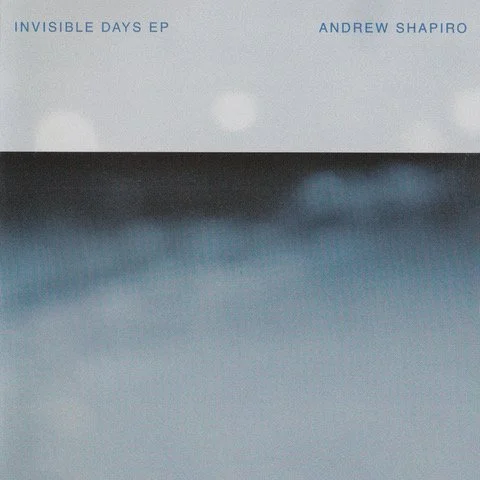
Listen SPOTIFY
Listen APPLE MUSIC
The big book that tells me made me like you right away
Monumental pieces by yourself?
Like the beauty that the rust creates on your curved scarred steel
And I rubbed it and I scratched it and I stained my hand and I stained your art
A haunting scar remains in the floor
Like the small pink curved one that I got when I slipped while climbing up my fire escape
Steel wishing it would fall
You probably know how far my mind had fallen
You sixty-year-olds all have faces on heads controlling hands
Looking like they carried their own equipment a long time ago
And is that long time ago now me?
American Minimalism as a visual art form would also play a role as a major influence [on Shapiro], particularly the photorealism of Chuck Close and the giant steel sculptures of Richard Serra. In 1979, Serra was commissioned by the American government to make a large-scale work for the courtyard outside of the Federal Plaza building in downtown Manhattan. What he came up with, Tilted Arc (1981), (a 120-foot-long steel plate bisecting the courtyard diagonally, dwarfing humans, and, like all Serra’s work, sitting in a space between fragile danger and tensile strength) seemed the last straw for a public fed up with high conceptual art. Against Serra’s wishes, the piece was dismantled and destroyed in 1989. For Shapiro’s first EP Invisible Days, (2003) Shapiro wrote the song Richard Serra as a tribute to Serra’s ordeal and also as an homage to Shapiro’s heroes, New York visual and musical artists of Serra’s generation, Close, [Michael] Riesman and [Philip] Glass among them.
—Mark Prendergast, author, The Ambient Century.
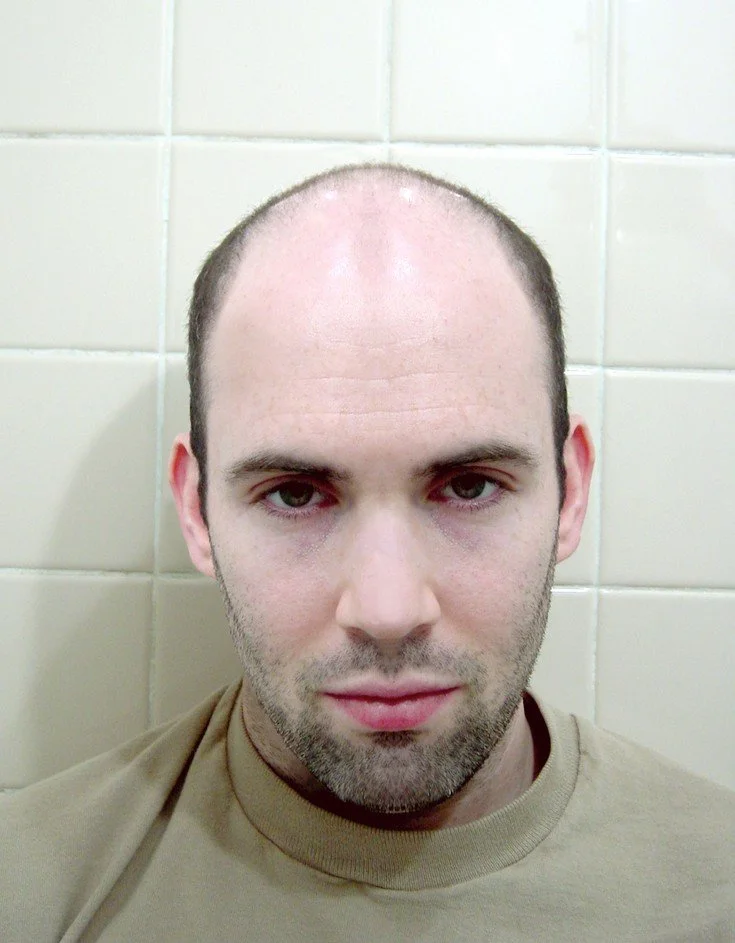
“leaving ny [Andrew]” by Peter Wu, 2002
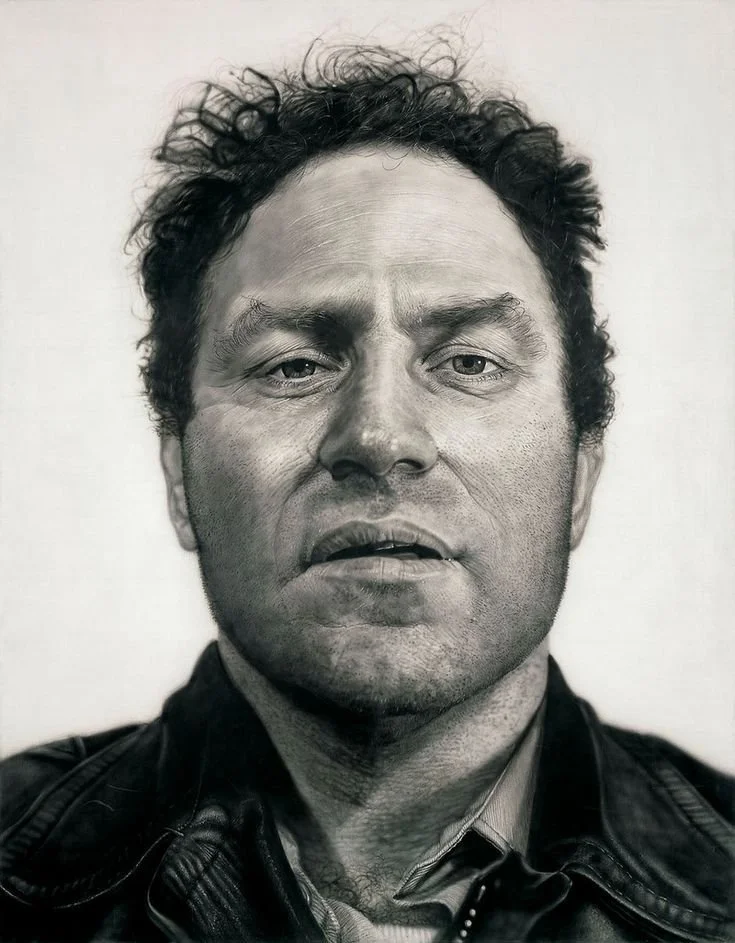
“Richard” by Chuck Close, 1969
From the archive: Invisible Days by Andrew Shapiro
Originally published in non-art.com, Issue #4 ("on artificiality"), May 2003 (revised 2026)
"Richard Serra" from my four-song recording debut Invisible Days EP (Airbox Music 04, released 2003) is an art-pop song based upon my experience of seeing Richard Serra's sculpture "Switch." I was first astonished by the breathtaking size and weight of the steel (the most prominent characteristics of any Serra sculpture). Then, after walking through the hallways created by its six pieces of curved steel, I eventually discovered a tenderness in the material. This was probably due largely to the pumpkin-colored rust covering the surface of the steel that resulted from its oxidation. The rust's heterogeneous sprawl over the surface was oddly perfect yet at the same time so natural—similar to that of bark on a tree or the grain in its wood. Serra used this natural circumstance as an incredible artificial aid. I got the idea after seeing this piece that I should write a song about Richard Serra.
Immediately after this, I interviewed Michael Riesman during a break from his rehearsal with the Philip Glass Ensemble. (Michael is the long time musical director of the Ensemble as well as a producer of Philip Glass's music.) After chatting with Michael and Philip Glass (who has collaborated with Serra in the past) about Serra's work, I came closer to knowing how I would approach writing the song. "Richard Serra" wouldn't only be about Richard Serra, it would also convey my devotion to other New York "downtown" artists of his generation (Riesman and Glass among them) as well as my fortune to have made a personal connection with many of them.
I've come to notice that like Serra's sculpture "Switch," my song "Richard Serra" also offers an initial impression that gradually gives way to another. While the computer-perfected pulse and polished sparkling sounds coming from the synthesizer give a first impression that the music is a wholly electronic affair, over time, this impression fades as the sugary monotone of the vocals and the human "chiff" of the flute invariably reveal a tender humanism. The listener eventually discovers a truly "human" performance. "Richard Serra's" fusion of natural and artificial sounds is reminiscent of the manner in which Serra himself turns a seemingly cold, industrial exterior into one of warmth by injecting a humanism (such as the colored rust or the graceful sweeping curves in the steel) that the viewer discovers gradually.
All together, the Invisible Days EP can best be described as a lush hybrid of the natural and the artificial (vocals and flute along with synthesized saxophones, vibes, harpsichords and basses in addition to a wide variety of other sounds and treatments). After listening, however, one may be able to understand a character that exists just below its surface: the music draws upon and attempts to interpret and interact with the aesthetics of the visual art that inspired its creation.
About the photograph leaving ny [Andrew] by Peter Wu
leaving ny [Andrew] by Los Angeles artist Peter Wu first appears as an ordinary photo portrait. Yet, one soon develops a feeling that there is something not quite right about it. Wu has created a play between my natural face and an artificial enhancement of it. He deleted, vertically, one half of my face. Then he copied the remaining half, inverted it and pasted it next to itself to create a perfect symmetry (my eyes are perfectly the same, for example). Then he went back to the deleted half and imported its blemishes onto the "new" half. This presents a subtle disturbance in perception—one is not initially seduced by the depth at hand (there's nothing otherwise complex about the portrait) and yet at the same time the subconscious finds it oddly complex and mysterious. (When I showed the portrait to Michael Riesman and then told him what Wu had done, he wondered how one would even know to look for such a thing.)
For me, leaving ny [Andrew] brings to mind the photorealist (some say hyperrealist) portraits that Chuck Close painted of his friends in New York in the 1960s and 70s (Richard Serra among them). Close's portraits now seem to me a tribute to that world. But where Close used a brush to bring the subject disarmingly close to the viewer (by highlighting the natural blemishes in their faces), Wu uses the computer to create a similarly jarring experience that goes one step further: Wu brings forth a symmetrical enhancement as well—one that scientists especially believe to be attractive. Indeed, Wu has created something quite remarkable, a human-artificialness that seems a fitting metaphor for the thoughts and experiences that existed and still exist in my mind that inspired the music: a slow release of initial judgements to ones of deeper understanding.
New York, April 2003
"RICHARD SERRA" (from the ANDREW SHAPIRO album INVISIBLE DAYS)
(P) & © 2003-2019 by Airbox Music Publishing LLP (ASCAP), Brooklyn, NY.
All rights reserved. Unauthorized duplication is a violation of applicable laws.